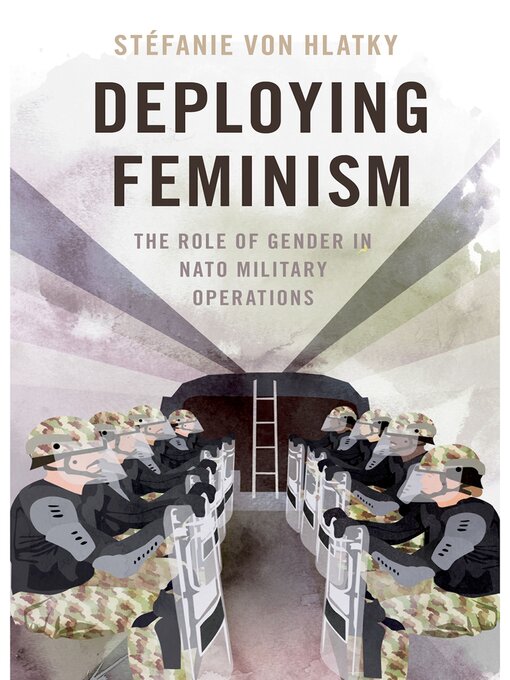
Deploying Feminism: The Role of Gender in NATO Military Operations
A detailed account, based on fieldwork and interviews, of how Women, Peace and Security norms are militarized and put at the service of operational effectiveness. International organizations and governments want to increase women’s participation in military operations and peacebuilding. Gender equality is increasingly seen as the antidote to conflict, a key factor in achieving stability. While feminist activism inspired the emergence of these norms on gender and conflict, they were institutionalized through the Women, Peace and Security (WPS) agenda, with the military at the forefront of those changes. In Deploying Feminism, Stéfanie von Hlatky tells the story of how the military has been delegated authority to advance gender equality as part of their activities, while simultaneously tackling increasingly complex threats. Drawing upon fieldwork and interviews, she illustrates how NATO, the world’s foremost alliance, has even embedded these ideas in the planning and execution of its missions. For troops deployed on NATO missions, this often means seeking out women in their operating area to improve intelligence gathering activities. While this helps the mission, does it help women and conflict-affected communities? Because of the military’s focus on operational effectiveness above all else, von Hlatky argues that there is a distortion of WPS norms, as gender equality concerns fade into the background. Looking at NATO’s ongoing operations in Iraq, Kosovo, and the Baltics, Deploying Feminism details the process by which Women, Peace and Security norms are militarized and put at the service of operational effectiveness. Further, it shows why an adjustment is necessary for gender equality to become a true planning priority.
In short, Stéfanie von Hlatky’s Deploying Feminism is a tour de force. It is a powerful book which opens the door to further critical, yet practical, studies of the way militaries approach gender and diversity
Reviewed by Charlotte Duval-Lantoine, Vice President, Ottawa Operations and a Fellow at the Canadian Global Affairs Institute

American Allies in Times of War: The Great Asymmetry
This book focuses on military cooperation between the United States and its allies in times of war and asks: why are allies so unpredictable? It shows that alliance demands related to military cooperation cannot always be fulfilled by democratic allies due to domestic political constraints. Additionally, concerns over military feasibility can further constrain governments in committing resources to war. Taking these constraints into account is key to explaining the varying levels of military cooperation between democratic allies. This book also explains how American allies can turn down US requests for political and military support. It shows how these allies can deploy strategies to overcome power asymmetries by resorting to leveraging, hedging, and compensation tactics. While they can rarely influence their dominant alliance partner decisively, they are successful in resisting pressures exerted by the US. The argument builds on three central claims. First, power asymmetries between allies translate into different assessments of international threats. Second, when disagreements over threats arise, the outcome of intra-alliance bargaining is not necessarily dictated by the stronger power. Third, secondary states face a policy trade-off between establishing a reputation as a reliable alliance partner and pursuing politically-safer alternatives. The empirical focus of the book is on formal US allies, as they have the most to gain or lose by going along with American plans. The case studies are the United Kingdom, Canada, and Australia’s response to the war in Afghanistan and the war in Iraq during the period from 2001 to 2003.
Von Hlatky is particularly effective at challenging beliefs that may appear, otherwise, to have been relegated to the realm of unchallenged assumptions
Reviewed by James T. McHugh, University of Akron and Carleton University